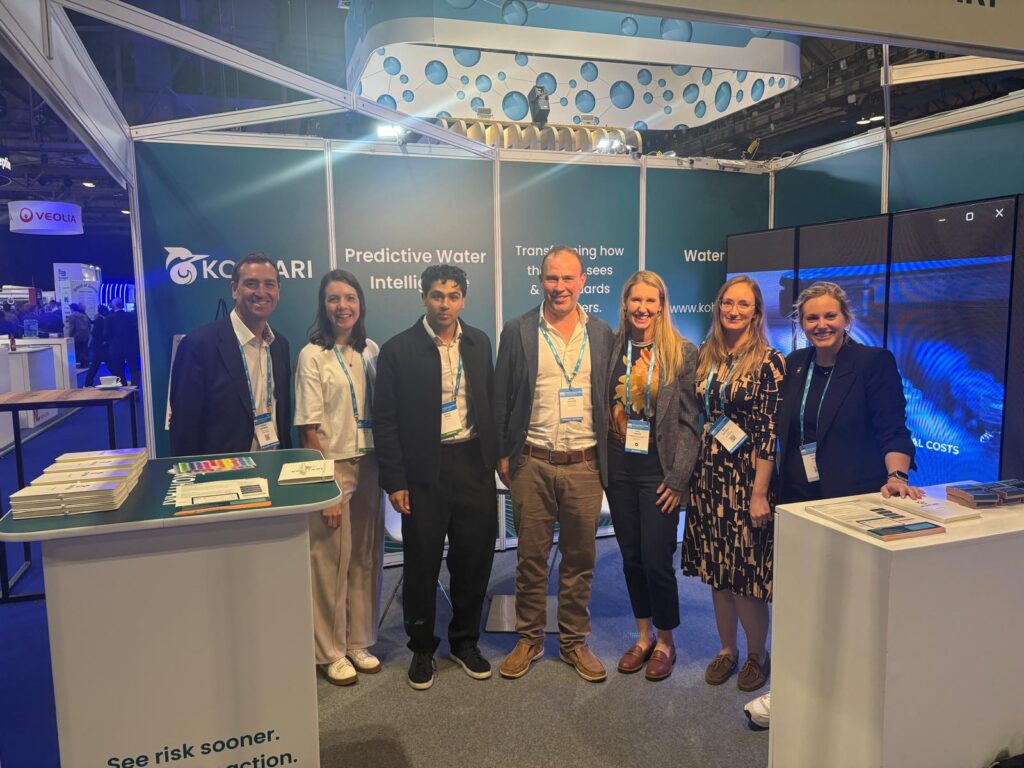
The International Water Association’s World Water Congress, held in Glasgow, brought people together from across the global water sector to share ideas, challenge thinking and talk honestly about the pressures facing water today.
For the Kohtari team, it was a jam packed week full of brilliant conversations.
Our CEO, James Sumsion, joined an Innovation Panel led by Martin Jackson, CIO at Northumbrian Water. James, Amy Raynor and Adrian Goodsell also shared more about WaterIQ on the Digital Water Stage, where we were joined by Microsoft’s Simon Mahon, with the stage expertly hosted by Oliver Grievson.
Later in the week, we held a Business Forum session and hosted drinks at the Red Sky Bar, giving us another chance to continue the conversation in a more relaxed setting.
We were also delighted to be joined for the event by Kristin Shaw, LEED AP and Ann Larson all the way from Michigan, US, who Kohtari will be working with as part of the MI Office of Future Mobility and Electrification Advanced Air Mobility Statewide Challenge.
From the stand to the speaker sessions and everything in between, one theme came through clearly: the water industry is not short of challenges. The harder part is knowing which risks are changing, how they connect and where to act first.
That was also reflected in a simple question we asked visitors to our stand:
What is your biggest drinking water challenge?
We asked attendees to add coloured dots to our world map to represent the drinking water challenge they were seeing most clearly in their region.
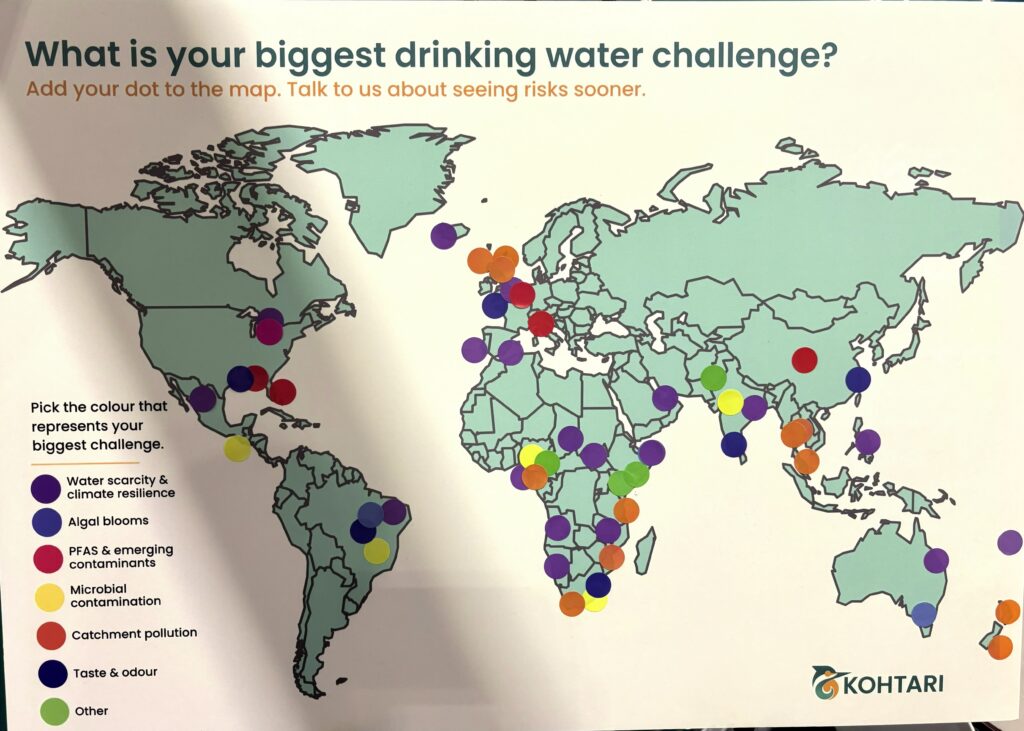
The patterns we saw were really interesting, if perhaps not all that surprising.
Across 54 responses, water scarcity and climate resilience came out as the biggest concern, with 18 dots. Catchment pollution followed with 12. Together, those two categories made up more than half of the responses.
That stood out.
Not because these issues are new. Water companies around the world know these pressures well, and increasingly so.
What stood out was what they represent: wider environmental and source-water pressures that can change quickly, interact with other risks and affect drinking water long before a treatment works is dealing with the consequences.
That is the real challenge.
Not simply knowing that risks exist, but knowing the why behind them and seeing how they are changing early enough to make better decisions.
Climate change is accelerating risks
Water scarcity and climate resilience being the most selected category on our map was not surprising.
Climate pressure is already changing how the sector thinks about resilience, supply, catchments and long-term planning.
A dry period can increase pressure on supply and change abstraction decisions. Warmer source waters can increase biological activity. Heavy rainfall can increase runoff from catchments.
In other words, climate resilience is not just a separate category on a risk register.
It is increasingly shaping many of the drinking water risks teams are managing every day. And many of those risks have indicators that start long before the water reaches the treatment works.
If those responsible for water quality can see those indicators earlier, they have more time to plan, investigate and take targeted action.
More data is not the same as better evidence
Water companies already collect a lot of data. The challenge is that these signals are often fragmented.
They may sit in different systems, be reviewed by different teams or only become meaningful once an issue has already escalated.
That makes it harder to build a clear picture of what is changing now, what is likely to happen next and where teams should focus attention.
Risk does not arrive neatly labelled
The drinking water challenges discussed in Glasgow were wide-ranging: water scarcity, climate resilience, catchment pollution, taste and odour, PFAS and emerging contaminants, microbial contamination, algal blooms and other local pressures.
It was also clear that risks do not always behave in isolation. That makes prioritisation harder and earlier visibility more valuable.
Water companies need to see multiple risk factors together, understand which ones are changing and decide where action is needed before issues become incidents.
Taking a broader approach to drinking water risk
Our work with BloomIQ has shown the value of predictive intelligence for algal bloom risk. But the conversations we had in Glasgow reinforced something broader.
Algal blooms matter, but they are one part of a wider drinking water risk picture, and one that although may be a key issues for some, it’s not a one size fits all and priorities vary and change. That is the thinking behind our AI-native drinking water intelligence platform, WaterIQ.
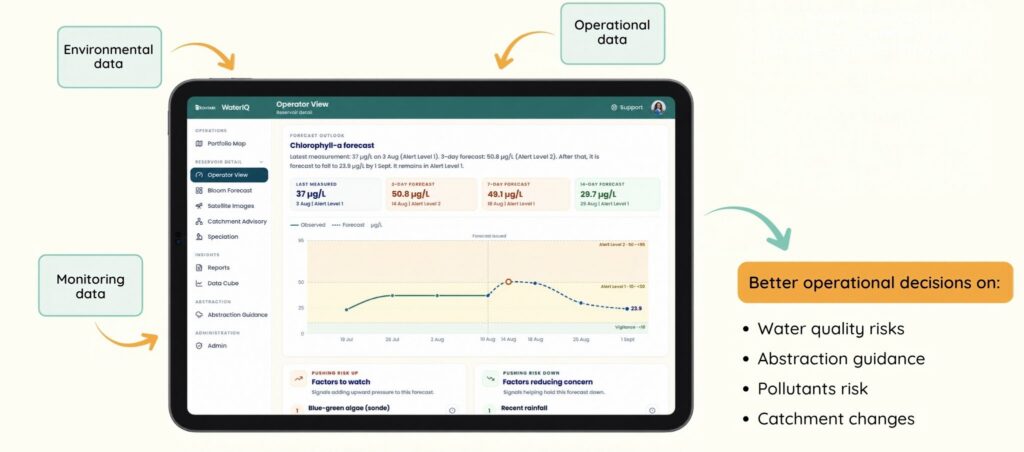
It brings together environmental, monitoring and operational data around the challenges that matter most to each water company, enabling more confident decisions on the issues that are most pressing.
And we don’t do this by simply adding more noise. Our platform turns those fragmented data points into a predictive view of where risk is building, and we work closely with teams to ensure those indicators are turned into data-led decisions.
Seeing risk sooner
Drinking water risk is rarely shaped by one factor alone.
The bigger challenge is understanding how different risks connect, how they change over time and what they mean for operational decisions.
That is where the sector has an opportunity to move from reacting to issues to anticipating them. It was brilliant to see so much energy and interest in that shift across the congress and exhibition.
Thank you to the International Water Association for a fantastic event, and to everyone who stopped to chat with us or attended one of our sessions.
You can find out more about WaterIQ, our predictive intelligence platform for drinking water risk, here – and we’d love to hear your thoughts.